



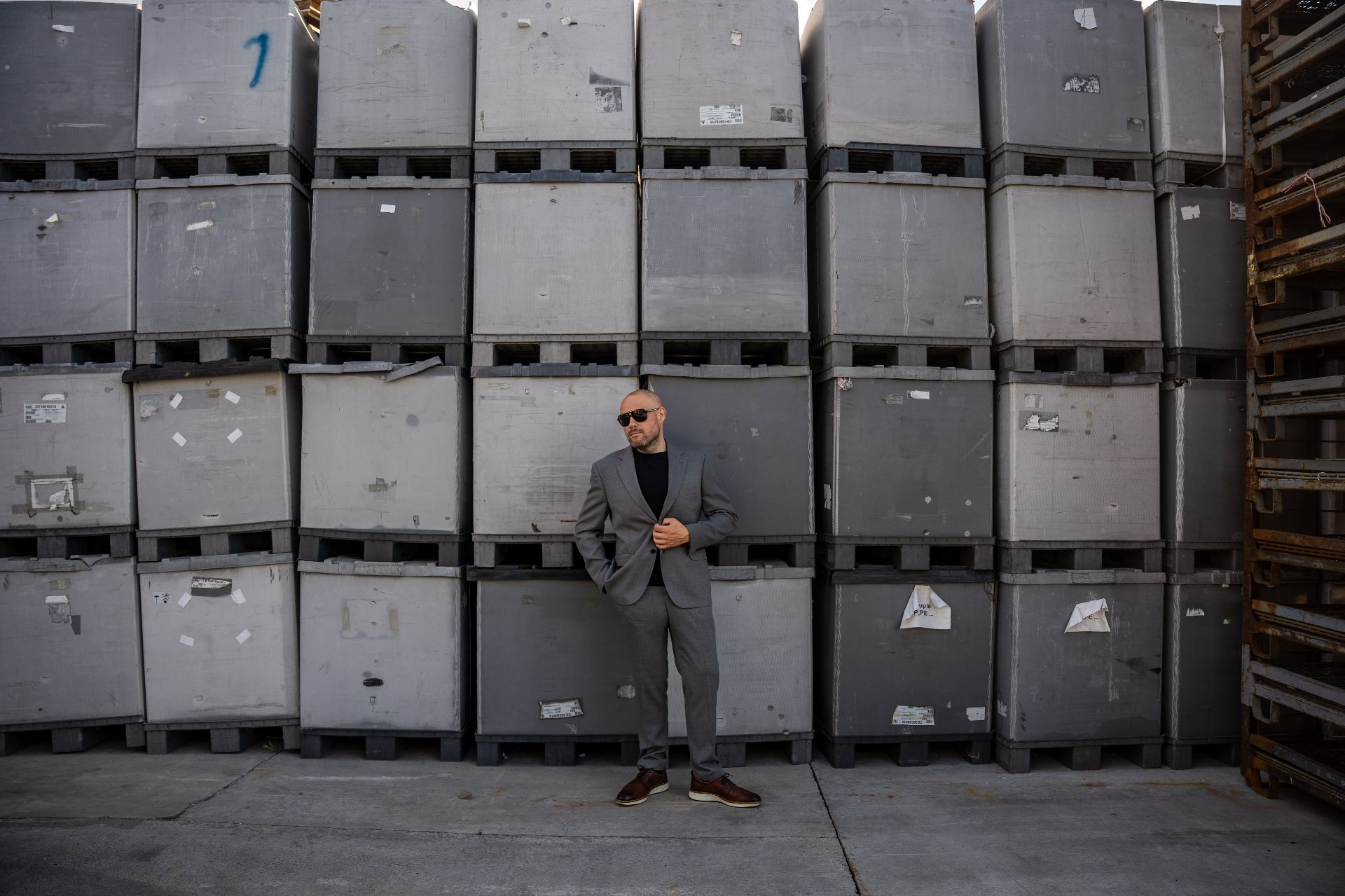
Plastic-Trader: Pioneering Spirit and Continuous Adaptation
An interview with Paweł Górnik, Managing Director of Plastic-Trader, discussing the company's 20-year success, innovations in airbag recycling, and the future of the circular economy.
Heartfelt congratulations on winning this year's charity auction for the Great Orchestra of Christmas Charity (WOŚP), organized by our editorial office. What motivated you to participate in this campaign?
Thank you very much for the congratulations! It is a great joy and honor for us. Participating in the auction for the Great Orchestra of Christmas Charity is a natural reflex for Plastic-Trader and a permanent element of our corporate social responsibility philosophy. We deeply believe in WOŚP's mission – saving lives and health, especially of children, is a goal that resonates perfectly with our values. We wanted to contribute our brick to this noble initiative, and your auction was a perfect opportunity to combine real support with the promotion of recycling and sustainable development ideas.
Your company has been operating on the market for over 20 years. What are the main factors that have influenced your success?
Two decades in the recycling market is a reason for pride and proof for us that our work makes sense. Our success is the result of consistent work, constant innovation, and deep commitment. The key factor is, above all, the pioneering spirit and continuous adaptation: from the beginning, we have focused on plastics, always looking for new, effective recycling methods and following global trends. This allowed us not only to survive but also to maintain a leadership position in a dynamically changing environment.
Equally important is high quality and trust. We build long-term relationships with customers and partners, offering products and services of the highest quality, which is also confirmed by the international certificates we have obtained, such as RecyClass. They are a guarantee of our reliability and commitment to the circular economy. We also have a committed and experienced team of experts who are the heart of Plastic-Trader. Their knowledge, passion, and openness to global markets are invaluable in daily activities and the development of new technologies.
Furthermore, we treat sustainable development as a foundation. Recycling is by nature a pro-ecological activity, and we have always focused on solutions that are not only business-effective but, above all, beneficial for the environment – which we confirm by basing our activities on renewable energy sources.
Please tell us about the company's activity profile: what do you currently do and what specifically do you offer to customers?
For over 20 years, Plastic-Trader has established its position as a specialist in comprehensive plastic recycling. We are a supplier of high-quality regranulates and regrinds obtained from various types of industrial and post-consumer waste, which then return to circulation as a valuable raw material.
Currently, in response to growing market demand and our mission to promote the circular economy, we are significantly expanding our activities. We are introducing innovative solutions in the field of metal recycling, recycling of airbags and seat belts, advanced material separation, and the use of renewable energy sources.
We have started recycling a wide range of metals, offering customers clean metal fractions for reuse in industry. Recycling of airbags and seat belts is our breakthrough area. We have developed an innovative and fully safe method for neutralizing pyrotechnic charges, which allows us to recover valuable materials – both plastics and metals – from this complex waste. This opens up completely new possibilities for the automotive industry in managing used components.
Regarding advanced material separation, we invest in state-of-the-art equipment that allows for precise separation of different fractions, maximizing the efficiency of recovery of both plastics and metals. What's more, our new processes are largely powered by renewable energy, which minimizes our carbon footprint and makes our services even more sustainable and ecological.
Which issues regarding the plastics industry are most important for you as a company? Which ones do you focus on most?
In the plastics industry, which is currently undergoing a fundamental transformation, four issues are key for us: innovation, sustainable development, energy efficiency, and global markets. The circular economy is our mission and future. Therefore, we focus on creating comprehensive solutions that allow for multiple reuse of raw materials, minimizing the amount of waste. Our new services in the field of airbag and metal recycling fit perfectly into this trend, and the certificates we hold, such as RecyClass, confirm our commitment to circular economy standards.
In terms of innovative technological solutions, we are particularly proud of our approach to neutralizing pyrotechnic charges in airbags. We show that we are not afraid of difficult challenges and look for breakthrough solutions that open up new possibilities in recycling even the most complex waste. At the same time, we want to be an example for the industry that recycling can be conducted in a way that minimizes environmental impact. That is why we invest in technologies powered by renewable energy, which makes our operations more sustainable and future-oriented. It should also be mentioned that our experience allows us to function effectively in the international arena, which can be seen in obtaining and offering innovative solutions on a global scale.
It cannot be denied that proper waste management and its transformation into new, valuable materials are key issues for the plastics sector and its future. What do you think are the biggest challenges in these areas of activity and how do you deal with eventual difficulties/problems on a daily basis?
I fully agree – these are absolutely key issues on which the future of the entire industry depends. The greatest challenges related to them certainly include dealing with the complexity and contamination of the waste stream. These issues often hinder effective and economical recycling, which requires investment in increasingly advanced technologies. The necessity of education and unification of legislation is also important. We need continuous public education in the field of segregation and uniform and supportive regulations that would favor the secondary raw materials market and investments in recycling. Other challenges are high investment costs in innovative technologies. Developing and implementing advanced recycling systems, especially those for difficult waste fractions, requires significant financial outlays.
How do we deal with this? Innovation and continuous technological development are our answer to these challenges. Our new, advanced separators are a direct response to the complexity of waste – they allow us to precisely separate different material fractions, even from the most complicated streams, such as the mentioned airbags or mixed metal and plastic waste. We are constantly investing in R&D, looking for new methods and processes that will increase recycling efficiency and allow for the recovery of more and more new types of materials. Our innovative way of neutralizing pyrotechnic charges is the best example of these activities.
Thanks to over 20 years of experience in global markets, we are able to quickly adapt to changing regulations and needs, as well as acquire best practices from different regions of the world. Furthermore, having international certificates, such as RecyClass, gives us an advantage and builds trust, and also helps in navigating industry regulations and standards.
What are the future plans for the development of Plastic-Trader's product and service portfolio?
Our plans for the future are ambitious and focus on further expanding the offer towards comprehensive solutions for the circular economy, with emphasis on innovation and sustainable development. We want to strengthen our position in the field of metal recycling and innovative recycling of airbags and seat belts, becoming a leading partner for the automotive, military, and other sectors generating these specific, difficult-to-manage wastes. We will also explore the possibilities of recycling other, non-standard waste streams.
Ultimately, we plan further intensive investments in technologies powered by renewable energy sources so that our entire process is as ecological and independent as possible, minimizing our impact on the environment. Our goal is to become a global point of reference in terms of effective and ecological recycling.
Interviewer: Agata Mojcner